
AI
Agentic
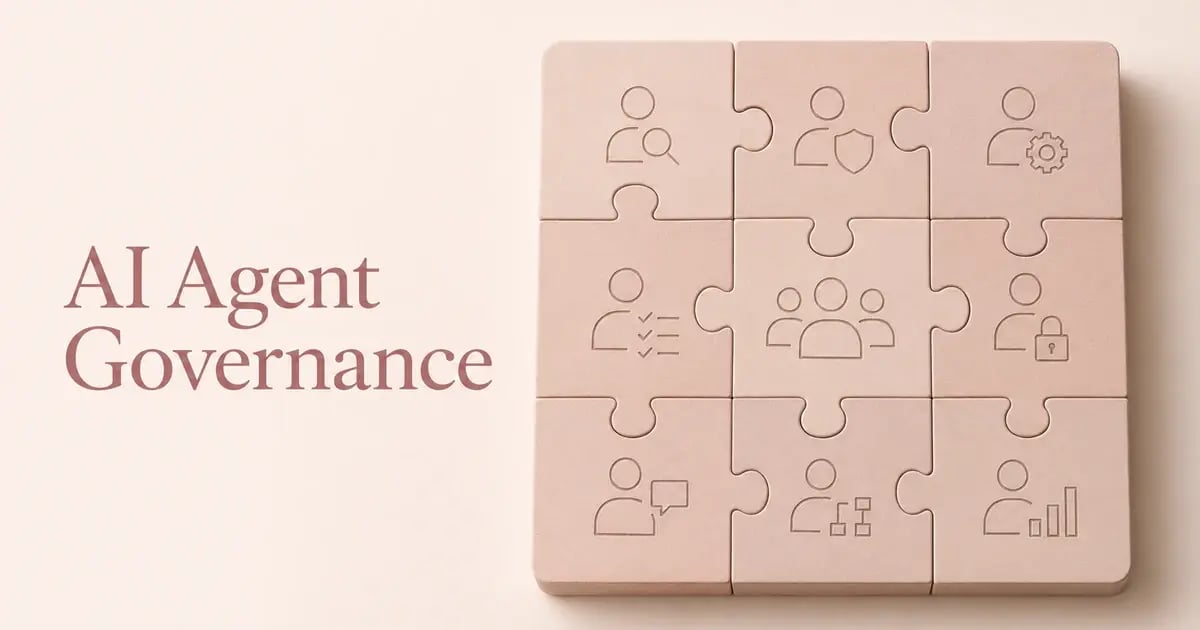

AI agent governance is the set of policies and technical controls that define how AI agents operate inside an enterprise. It establishes what an agent can access, which actions it can take, where human approval is required, and how its activity is monitored and reviewed.
The controls applied to an agent should reflect the authority it has within a workflow. An agent that retrieves information carries a different operating risk from one that updates records, triggers transactions, changes system configurations, or acts directly on a business decision.
AI agent governance defines the operating boundaries around enterprise AI agents, including their purpose, permissions, decision authority, oversight requirements, and accountability.
An AI agent may be able to retrieve information, call APIs, use enterprise applications, communicate with users, delegate work, or take actions that change another system. Governance determines which of those capabilities are available and the conditions under which they can be used.
A practical agentic AI governance model typically defines:
AI agent governance sits within the organization’s wider AI governance policy. The broader policy establishes enterprise expectations for AI use. Agent governance translates those expectations into operating controls for individual agents and workflows.
Governance can also extend to the instructions that shape agent behavior. Prompt governance addresses how prompts and system instructions can be managed as governed enterprise assets.
The more independently an AI agent can act, the more carefully its authority, access, approval requirements, and operating limits need to be defined.
Agent autonomy describes how independently an AI agent can progress through work and take action without waiting for a person at every step.
A useful enterprise model can distinguish between several levels of authority:
The controls around each level should reflect what can happen if the agent is wrong, acts on incomplete information, or operates outside its intended role.
An observing agent may require tightly controlled data access and logging. An agent that can execute transactions or modify records may also need action limits, approval thresholds, continuous monitoring, and a mechanism for stopping activity when expected conditions are breached.
This is why governance cannot be applied only at the level of the technology category. Two systems described as “AI agents” may have very different responsibilities and levels of authority.
AI agents should receive only the data, tools, and system permissions required for their defined role, with access controlled and traceable at the level where actions are actually performed.
An agent supporting customer onboarding, for example, may need access to submitted documents and selected customer records. That does not automatically justify access to every customer database, administrative function, or downstream transaction system.
Useful controls include:
Access should also be reviewed when the agent’s responsibilities change. Adding a new tool, data source, workflow, or capability can materially alter what the agent is able to do.
In multi-agent environments, agent orchestration determines which agent receives work and when it acts. Governance determines whether that agent has the authority to perform the requested action.
Human approval should remain at points where the organization requires a person to accept responsibility before an action takes effect or where the consequences exceed the agent’s approved operating authority.
The appropriate review points depend on the workflow, the level of autonomy assigned to the agent, and the impact of an incorrect action.
Human approval may be appropriate when:
A human-in-the-loop design places these review points directly into the workflow. The reviewer should receive the proposed action, relevant evidence, and the reason the case was escalated.
Human oversight also needs clear ownership. Sending uncertain cases to a general review queue does not create meaningful control if no person or team is accountable for making the decision.
Production AI agents require ongoing monitoring, ownership, permission reviews, and controlled change management because their behavior and operating environment can change after deployment.
Governance therefore continues throughout the AI agent lifecycle.
Teams should be able to see:
Enterprise AI monitoring provides the wider operational visibility needed to inspect AI behavior in production.
Changes to an agent should also trigger governance review where appropriate. New tools, expanded permissions, different models, additional data sources, or changes in workflow responsibility can alter the risk profile even if the agent retains the same name and business purpose.
Ownership should remain clear throughout this process. Business owners are responsible for the outcome the agent supports, while technical and platform teams maintain its implementation. Data, security, risk, compliance, and other teams may own specific controls relevant to their domains.
When an agent is retired, credentials, integrations, and permissions should be removed so unused systems do not retain access simply because they are no longer active.
AI agent governance becomes increasingly important as agents gain access to enterprise data, business systems, customer interactions, and operational decisions. The organization needs a clear view of what each agent is allowed to do and how those boundaries are enforced once the system is live.
If you are preparing AI agents for production or reviewing agents already operating across enterprise workflows, Fulcrum Digital can help define the governance architecture around autonomy, permissions, human approval, monitoring, and lifecycle control.
Explore how governance frameworks can support enterprise agentic systems as deployment expands, including oversight, traceability, accountability, and the controls required around production use.
Read how increasing AI autonomy changes the accountability questions enterprises need to answer around decision scope, human oversight, operating boundaries, and responsibility.
Permissions should be reviewed whenever an agent’s responsibilities, tools, data access, or workflow authority change, with periodic reviews used to identify access that is no longer required.
Yes. An agent can be given more or less authority over time, but any change in autonomy should trigger a review of its permissions, approval requirements, monitoring, and operating limits.
Governance applies to individual agents as well as the interactions between them, including role boundaries, data sharing, delegation authority, orchestration rules, and accountability for the final outcome.
The system should be able to block or stop the action, preserve a record of what occurred, and route the incident for investigation before normal operation resumes.
Useful records include agent ownership, approved purpose, permissions, system interactions, actions taken, approvals, escalations, configuration changes, and the versions of prompts, models, policies, and tools used during execution.
AI Governance Policy
AI Agent Lifecycle Management
Human-in-the-Loop
Enterprise AI Monitoring
Prompt Governance
Agent Orchestration
Multi-Agent Systems
Enterprise Agentic AI Platform
AI Compliance