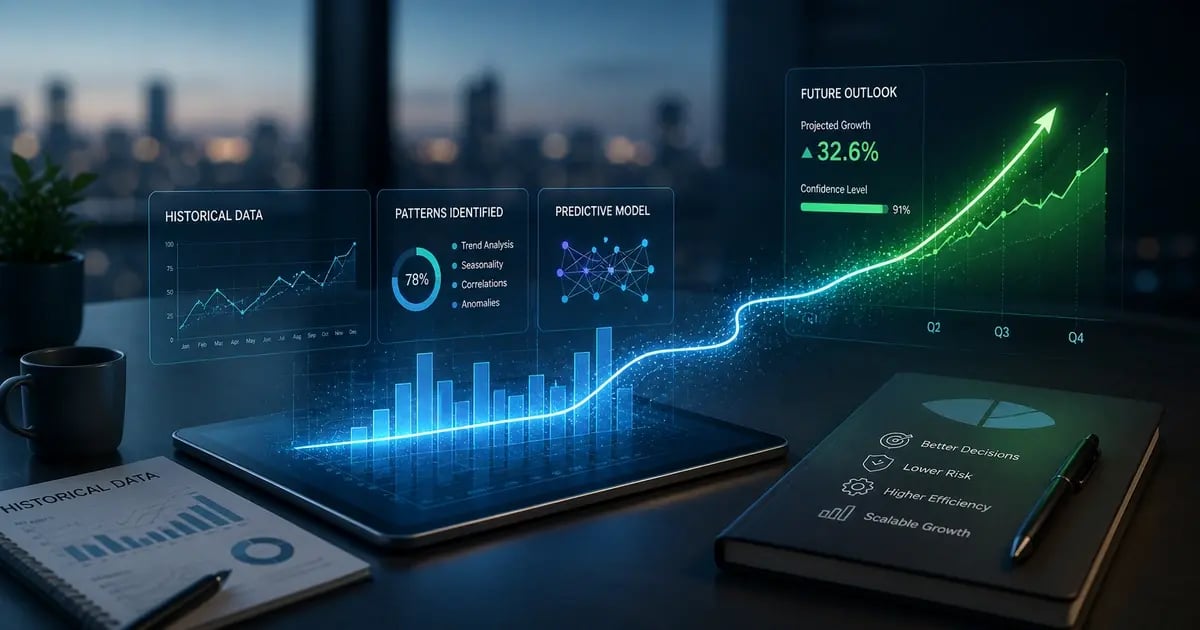
Predictive analytics uses historical data, statistical models, and machine learning to forecast future outcomes with a measurable level of probability. It helps organizations move from reporting what happened to anticipating what is likely to happen next.
In enterprise settings, AI predictive analytics is widely used across operations, finance, marketing, and supply chains to improve planning, reduce risk, and guide decisions using AI-driven insights. It is a core capability within modern enterprise analytics solutions and business intelligence analytics ecosystems.
What is predictive analytics and how does it work?
Predictive analytics combines historical data, pattern recognition, and statistical modeling to estimate future outcomes. It does not guarantee results, but it does improve decision quality by assigning likelihoods to different scenarios.
At a technical level, predictive modeling techniques analyze past behavior—such as transactions, customer activity, and operational logs—and identify relationships within that data. These relationships are then used to build models that can forecast outcomes such as demand levels, churn risk, equipment failure, or revenue trends.
Modern AI forecasting models extend this by using machine learning to refine predictions over time. As more data becomes available, the models adapt, improving accuracy and relevance. This is where AI data modeling and machine learning forecasting become central to predictive systems.
How is predictive analytics used in business?
Predictive analytics in business is applied wherever future outcomes influence decisions. It supports both strategic planning and day-to-day operations.
In customer-facing functions, it is used to predict behavior such as purchase intent, churn likelihood, or engagement patterns. In operations, it helps forecast demand, optimize inventory, and anticipate delays. In finance, it supports revenue projections, credit risk assessment, and fraud detection.
Many organizations embed predictive analytics solutions directly into workflows so that predictions are available at the point of decision. This shifts analytics from a reporting function to an operational capability within enterprise analytics solutions.
Fulcrum Digital’s FD Ryze platform applies this approach through purpose-built forecasting agents across logistics, demand, and sales. These systems analyze historical patterns, seasonality, and operational signals to generate forward-looking projections that teams can use for planning, budgeting, and inventory decisions. The emphasis is not just on generating forecasts, but on embedding them into day-to-day workflows where they influence real outcomes.
What makes AI predictive analytics different from traditional forecasting?
Traditional forecasting methods rely on predefined statistical models and relatively stable assumptions. They work well when patterns are consistent and data relationships are simple.
AI predictive analytics introduces flexibility. Machine learning models can handle larger datasets, more variables, and non-linear relationships. They can also update themselves as new data flows in, making them more suitable for dynamic environments.
Another difference is speed and scale. With real-time predictive analytics, predictions can be generated continuously as new data arrives. This allows organizations to respond faster to changes in demand, customer behavior, or operational conditions.
The result is not just better forecasts, but more responsive decision-making across the business.
What data and tools are required for predictive analytics?
Effective predictive data analysis depends on both data quality and the right tooling.
On the data side, organizations need access to consistent, structured datasets. This includes historical records, transactional data, and relevant external signals. Poor data quality limits the effectiveness of any model, regardless of how advanced the algorithm is.
On the tooling side, companies use a combination of predictive analytics platforms, predictive analytics software, and broader advanced analytics tools. These tools support model development, testing, deployment, and monitoring.
Many modern big data analytics solutions also integrate predictive capabilities, allowing teams to process large datasets and run forecasting models at scale. Together, these tools form the foundation of scalable data prediction tools used across industries.
What challenges do organizations face with predictive analytics?
Despite its potential, predictive analytics is not always straightforward to implement.
One challenge is model reliability. Predictions depend on the assumptions built into the model and the quality of the underlying data. If either changes, the accuracy of the forecast can degrade over time.
Another challenge is integration. Predictions are only useful if they are embedded into decision-making workflows. Many organizations generate forecasts but struggle to operationalize them within systems and processes.
There is also the issue of interpretation. Predictions are probabilistic, not definitive. Teams need to understand how to use them alongside business judgment rather than treating them as absolute answers.
Finally, scaling predictive analytics across the enterprise requires governance, monitoring, and continuous improvement. Without these, predictive analytics use cases remain isolated experiments rather than durable capabilities.
Related questions
How accurate is predictive analytics in practice?
Accuracy depends on data quality, model selection, and how stable the underlying patterns are. In well-defined use cases, predictive models can achieve high reliability, but no model is perfectly accurate.
Can predictive analytics work in real time?
Yes. Real-time predictive analytics processes incoming data continuously, allowing organizations to generate forecasts and act on them immediately.
What industries benefit the most from predictive analytics?
Industries with high data volume and repeatable patterns, such as finance, retail, logistics, and manufacturing, see strong results from predictive analytics applications.
Is predictive analytics the same as machine learning?
Not exactly. Machine learning is one of the main techniques used to build predictive models, but predictive analytics also includes statistical methods and domain-specific modeling approaches.
Related terms
Machine Learning
Data Analytics
Business Intelligence
Forecasting Models
Advanced Analytics
Data Engineering
AI Decision Systems
Looking to move from hindsight reporting to forward-looking decision-making?
Connect with Fulcrum Digital to explore how predictive analytics can be applied across your business to improve forecasting, optimize operations, and unlock more reliable insights at scale.
Book a call or Book a demo