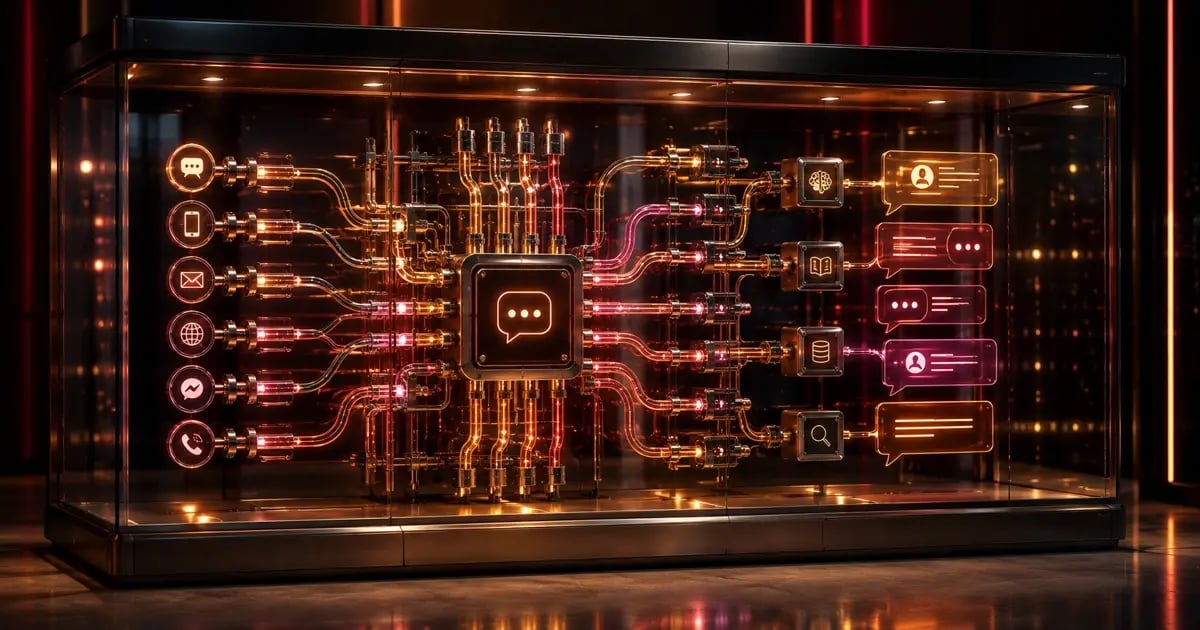
Chatbots are software applications that interact with users through text or voice conversations. Modern AI chatbots can answer questions, provide support, automate routine tasks, retrieve information, and guide users through digital experiences across websites, apps, messaging platforms, and enterprise systems.
Today’s chatbots range from simple rule-based assistants to sophisticated conversational systems powered by natural language processing, machine learning, and large language models.
What is a chatbot?
A chatbot is a conversational interface that allows users to interact with software through natural language. Rather than navigating menus or forms, users can ask questions, request information, or complete tasks through conversation.
The earliest chatbots relied on scripted responses and predefined decision trees. They were useful for handling repetitive requests but struggled when conversations moved beyond expected scenarios.
Modern AI chatbots, AI virtual assistants, and AI communication bots are far more capable. They can understand intent, access knowledge sources, connect with business systems, and maintain context throughout an interaction.
As digital channels have expanded, chatbots have evolved from simple support tools into an important component of customer experience, employee services, and business operations.
What business problems do chatbots solve?
Organizations deploy chatbots to improve responsiveness, increase availability, reduce operational workload, and make information easier to access. The goal is often to solve common service and support challenges without increasing staffing requirements.
Many support teams face growing volumes of routine questions that consume significant time but require relatively simple answers. Chatbots help address this challenge by providing instant responses to common requests.
Common operational benefits include:
- Reducing support volume
- Improving response times
- Expanding service availability beyond business hours
- Supporting self-service experiences
- Reducing repetitive manual work
- Improving consistency across customer interactions
This is why AI customer service bots, AI support bots, and customer service automation AI solutions have become increasingly common across both customer-facing and internal business functions.
How are enterprise chatbots built and deployed?
Enterprise chatbots rely on a combination of conversation design, knowledge sources, integrations, and deployment infrastructure. The quality of a chatbot often depends more on these foundations than on the conversational interface itself.
Organizations typically use chatbot development platforms and chatbot frameworks to design conversation flows, connect business systems, manage content, and deploy bots across multiple channels.
A modern chatbot may integrate with:
- CRM platforms
- Knowledge bases
- Ticketing systems
- ERP applications
- Ecommerce platforms
- Student information systems
- Internal business applications
Many deployments also use AI chatbot APIs, chatbot integration tools, and chatbot deployment tools to connect conversations with enterprise workflows and data sources.
The result is a chatbot that can do more than answer questions. It can retrieve information, initiate processes, update records, and support business operations directly.
How do organizations measure chatbot success?
A chatbot should be evaluated by the outcomes it produces, not simply by how many conversations it handles. Successful chatbot programs focus on operational impact, customer experience, and service quality.
Organizations commonly track metrics such as:
- Containment rate
- Resolution rate
- Customer satisfaction (CSAT)
- Escalation rate
- Response time
- Conversation completion rate
Many teams also use chatbot analytics tools to understand where users become frustrated, where conversations break down, and which interactions generate the highest value.
As chatbot deployments mature, performance measurement becomes an ongoing process. Analytics often reveal opportunities to improve knowledge coverage, streamline workflows, and strengthen the overall user experience.
What are the most valuable chatbot use cases today?
The strongest chatbot use cases tend to involve high-volume interactions, repetitive requests, and information-heavy workflows. These environments create opportunities to improve service quality while reducing manual effort.
In banking and financial services, chatbots assist customers with account inquiries, payment questions, service requests, and fraud-related support. In insurance, they help policyholders access information, track claims, and navigate service processes.
Retailers and ecommerce organizations use AI messaging bots to support product discovery, order tracking, returns, and customer service. Higher education institutions deploy chatbots to answer admissions questions, guide students through registration, and provide campus support information.
Healthcare organizations use chatbots for appointment scheduling, patient communications, and administrative inquiries. Across industries, the most successful implementations focus on improving accessibility while helping users complete tasks more efficiently.
Evaluating chatbots as part of your digital transformation strategy?
Connect with Fulcrum Digital to discuss practical chatbot use cases, deployment approaches, and opportunities for automation within your organization.
Book a conversation
Further Reading
Artificial Empathy in Enterprise AI Systems
As chatbots become more widely used across customer service, healthcare, education, and employee support environments, the quality of the interaction becomes just as important as the speed of the response. This article explores how enterprises are approaching tone, context, trust, and human-centered communication in AI-powered interactions.
Read the blog
Related Questions
Are chatbots and virtual assistants the same thing?
Not always. Chatbots are designed primarily for conversational interactions, while virtual assistants often combine conversation with task execution, workflow automation, and broader system access.
Can chatbots work without artificial intelligence?
Yes. Rule-based chatbots can operate using predefined workflows and decision trees. AI-powered chatbots generally provide more flexibility and can handle a wider range of requests.
What industries benefit most from chatbots?
Industries with high volumes of customer, employee, or user interactions often see the greatest benefits. Common examples include banking, insurance, retail, ecommerce, healthcare, telecommunications, and higher education.
Do chatbots replace human support teams?
Most organizations use chatbots to handle routine interactions while allowing human specialists to focus on more complex situations. Chatbots are often deployed as a complement to human support rather than a replacement.
Related Terms
Conversational AI
Virtual Assistants
Natural Language Processing (NLP)
Customer Experience Automation
Intelligent Automation
AI Knowledge Assistants
Generative AI