
AI
Insurance
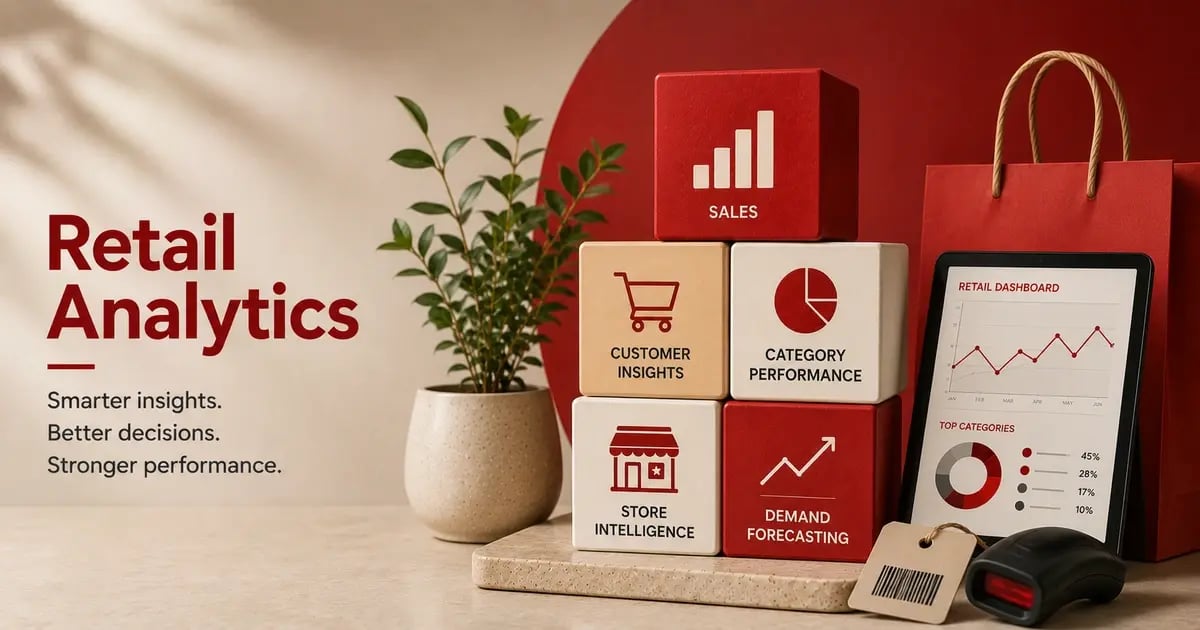

Retail analytics is the process of collecting, analyzing, and interpreting data from stores, ecommerce platforms, customers, products, and supply chains to improve business decisions. Modern retail analytics combines AI, predictive models, and real-time data to help retailers optimize inventory, personalize customer experiences, forecast demand, and improve overall business performance.
Rather than simply reporting what happened, today’s retail analytics solutions help retailers understand why it happened, predict what is likely to happen next, and recommend the best course of action.
Retail analytics refers to the use of data, reporting, and analytical tools to understand how a retail business is performing across sales, customers, inventory, marketing, merchandising, and operations. The goal is to turn large volumes of retail data into decisions that improve revenue, profitability, and customer satisfaction.
Retailers generate enormous amounts of information every day—from online purchases and point-of-sale systems to loyalty programs, mobile apps, supply chain data, and customer interactions. Retail analytics brings these sources together to identify trends, measure performance, and uncover opportunities that would otherwise be difficult to detect.
Modern retail analytics software has evolved beyond static reports. Many platforms combine traditional data analytics with AI-powered insights, giving retailers a more complete view of how their business is performing across physical and digital channels.
Retail analytics has become essential because retail itself has become significantly more complex. Customers now move between physical stores, ecommerce websites, marketplaces, social commerce, and mobile apps, creating a level of operational complexity that manual reporting can no longer keep up with.
Retail leaders are expected to make decisions about pricing, promotions, inventory, merchandising, staffing, customer loyalty, and fulfilment in near real time. Waiting for monthly reports is rarely enough.
This is where modern retail business intelligence, customer behavior analytics, and omnichannel analytics become valuable. Instead of simply measuring performance, they help explain why sales changed, which products are gaining momentum, where customers abandon purchases, and which actions are most likely to improve business outcomes.
For organizations investing in broader retail services modernization, analytics often becomes the foundation that supports digital transformation across every customer touchpoint.
The value of retail analytics lies in the quality of the decisions it enables. Better data allows retailers to respond faster, allocate resources more effectively, and reduce costly guesswork across day-to-day operations.
Retail analytics commonly supports decisions involving:
For example, inventory optimization agents can continuously analyze sales velocity, seasonality, supplier performance, and stock levels to recommend replenishment decisions before inventory problems affect customers.
Retailers also increasingly combine analytics with retail automation to trigger operational workflows automatically, reducing manual effort while improving speed and consistency.
Artificial intelligence is shifting retail analytics from descriptive reporting to intelligent decision support. Rather than simply summarizing historical performance, AI identifies patterns, predicts future outcomes, and recommends actions based on continuously changing data.
Modern AI retail analytics can support:
Using predictive analytics, retailers can anticipate changes in demand, identify products likely to experience stock shortages, and forecast purchasing behavior before it impacts sales.
The next step is operationalizing those insights. Enterprise AI platforms such as FD RYZE® help retailers move beyond dashboards by deploying AI agents that act on analytics. For example, an enterprise AI agent can recommend inventory adjustments, personalize shopping experiences, streamline merchandising decisions, or support AI conversion rate optimization (CRO) initiatives that improve digital commerce performance. In this way, analytics becomes the starting point for intelligent action rather than the final report.
Modern retail analytics connects data from every part of the business to create a continuously updated view of retail performance. Instead of analyzing stores, ecommerce, marketing, inventory, and customer behavior separately, organizations increasingly combine them into a unified decision-making environment.
Leading retailers use analytics to understand not only what customers purchased, but how they discovered products, how inventory levels influenced buying decisions, how promotions affected demand, and which operational changes are likely to improve future results.
As AI capabilities continue to mature, retail analytics is becoming less about generating reports and more about helping organizations make faster, better-informed decisions across merchandising, operations, customer experience, and growth.
Retail analytics delivers its greatest value when insights translate into measurable business outcomes. Whether you’re improving merchandising, optimizing inventory, personalizing customer experiences, or scaling omnichannel operations, the right analytics strategy can become a competitive advantage.
Connect with Fulcrum Digital’s retail services specialists to explore how AI-powered retail analytics can support your organization’s growth strategy.
Discover how AI helps retailers transform customer data into actionable insights that improve merchandising, customer engagement, inventory planning, and business performance.
Explore how AI-driven inventory optimization improves forecasting accuracy, reduces stockouts, lowers carrying costs, and strengthens supply chain performance across modern retail operations.
Retail analytics focuses specifically on retail operations such as sales, customers, merchandising, and inventory. Business intelligence is broader and supports reporting and decision-making across multiple business functions.
AI helps retailers forecast demand, segment customers, recommend products, optimize pricing, detect emerging trends, and generate insights from large volumes of retail data.
Retail analytics combines data from point-of-sale systems, ecommerce platforms, customer loyalty programs, inventory systems, marketing campaigns, mobile apps, supply chain operations, and customer interactions.
Customers interact with retailers across multiple channels before making purchasing decisions. Retail analytics helps organizations connect those interactions, measure performance consistently, and deliver a more seamless customer experience.
Data Analytics
Predictive Analytics
Retail Automation
Inventory Optimization Agent
AI Conversion Rate Optimization
Business Intelligence
Customer Analytics
Demand Forecasting
Omnichannel Retail