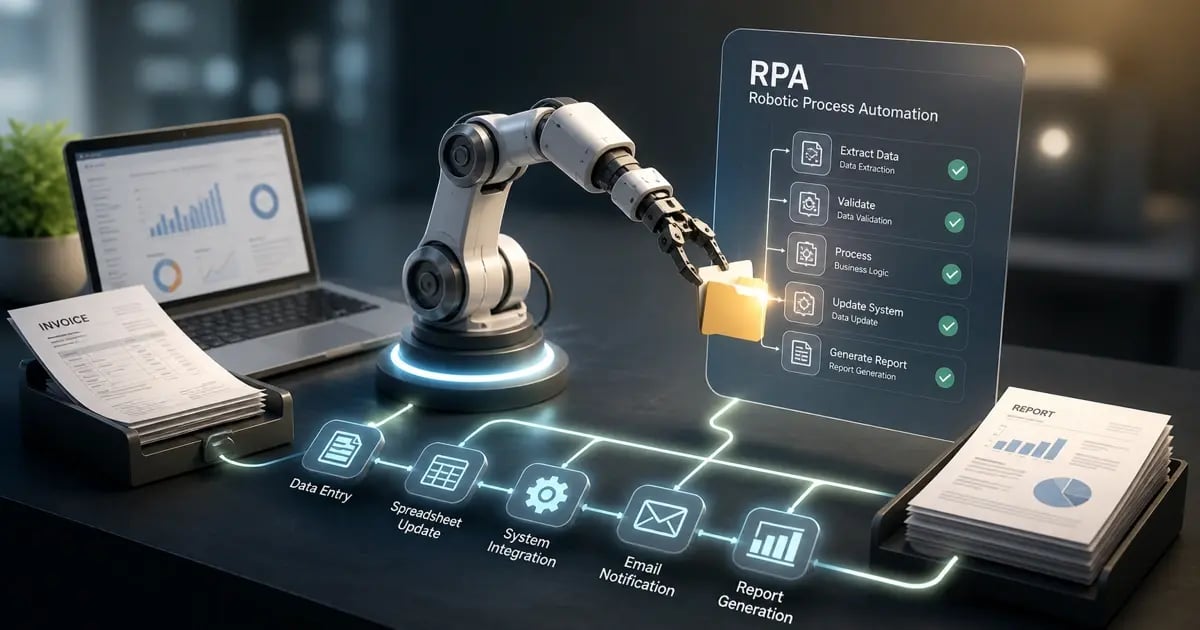
Robotic process automation (RPA) uses software bots to execute repetitive, rule-based tasks across systems and applications. It allows organizations to automate routine work such as data entry, validation, report generation, and transaction processing without changing underlying systems.
In enterprise environments, RPA solutions are often the starting point for broader business process automation. When combined with AI automation tools, RPA evolves into intelligent automation, enabling systems to handle more complex workflows that involve decision-making, data interpretation, and dynamic inputs.
What is robotic process automation and how does it work?
Robotic process automation works by mimicking how humans interact with digital systems. Bots are configured to follow predefined rules, like logging into applications, extracting data, updating records, and triggering actions across multiple platforms.
These bots operate through user interfaces or APIs, making them compatible with existing systems without requiring deep integration. That is why RPA software is often used in environments where legacy systems are still in place.
Modern RPA platforms extend beyond simple scripts to include orchestration layers, monitoring tools, and governance controls, allowing organizations to manage automation at scale as part of broader enterprise automation solutions.
How is RPA used in business operations today?
Automation in business operations is most effective in processes that are repetitive, structured, and high-volume. Common RPA use cases include invoice processing, claims handling, onboarding workflows, compliance checks, customer support tasks, and financial reconciliation. These are areas where manual effort is high and error rates can affect cost or service quality.
As organizations mature, they combine RPA with AI workflow automation to handle more complex scenarios. For example, document processing can move from simple extraction to contextual understanding when AI models are introduced. This is where AI-powered automation begins to expand the scope of what automation can handle.
How does RPA differ from intelligent automation and hyperautomation?
RPA on its own focuses on rule-based task execution. It works best when processes are clearly defined and stable.
Intelligent automation combines RPA with AI capabilities such as natural language processing, computer vision, and machine learning. This allows systems to process unstructured data, interpret context, and support decision-making within workflows.
Hyperautomation solutions take this further by connecting multiple automation tools such as RPA, AI, analytics, and orchestration into a coordinated system. The focus shifts from automating individual tasks to automating entire processes across systems and departments.
Understanding this progression helps organizations choose the right level of automation for their needs rather than expecting RPA alone to solve every problem.
Which industries benefit most from RPA?
RPA adoption is widespread because repetitive workflows exist across all industries, but the nature of those workflows varies.
In banking and financial services, RPA is commonly used for transaction processing, compliance checks, and reconciliation tasks. In insurance, it supports claims processing, policy administration, and document handling. In e-commerce and retail, RPA helps manage order processing, inventory updates, and customer service workflows.
In logistics and supply chain operations, robotic automation tools streamline shipment tracking, documentation, and coordination between systems. Across enterprise automation solutions, these use cases are unified by a common goal: improving accuracy, reducing manual effort, and increasing throughput.
What challenges do organizations face with RPA?
While RPA is relatively quick to implement, scaling it effectively requires discipline. One challenge is process stability. Bots depend on consistent workflows and system interfaces. Even small changes in applications can disrupt automation if not managed properly.
Another challenge is fragmentation. Without proper governance, organizations may deploy bots in isolated pockets, leading to duplication, inefficiency, and maintenance overhead. This limits the effectiveness of scalable automation solutions.
There is also the question of process selection. Automating inefficient processes does not create value. The strongest results come from identifying workflows where task automation software can reduce cost, improve speed, or enhance accuracy in measurable ways.
How does RPA fit into broader enterprise automation strategies?
RPA is often the entry point into automation, but its long-term value depends on how it is integrated into a larger strategy.
Organizations increasingly treat RPA as one layer within a broader automation stack that includes AI, data platforms, and orchestration tools. This allows them to move from isolated task automation to coordinated digital process automation across systems.
Fulcrum Digital supports this approach through its work in platform engineering, AI-driven automation, and modernization initiatives. Rather than deploying bots in isolation, the focus is on embedding workflow automation tools within connected enterprise systems so that automation contributes to larger operational outcomes. This includes integrating RPA with AI models, data pipelines, and decision systems to create more adaptive and scalable automation environments.
Related questions
Is RPA only useful for large enterprises?
While large organizations often deploy RPA at scale, smaller companies can also benefit by automating high-volume, repetitive tasks that consume time and resources.
Can RPA work with legacy systems?
One of the advantages of RPA software is its ability to interact with existing systems through user interfaces, making it suitable for environments with older technology stacks.
How long does it take to implement RPA?
Basic RPA use cases can be implemented relatively quickly, often within weeks. More complex, enterprise-wide automation initiatives take longer due to integration and governance requirements.
What is the difference between RPA and AI bots for business?
RPA bots follow predefined rules, while AI bots for business can handle variability, learn from data, and adapt to changing inputs when combined with machine learning or other AI techniques.
Related terms
Intelligent Automation
Hyperautomation
Workflow Automation
Process Mining
AI Automation
Digital Transformation
Enterprise Systems Integration
Connect with Fulcrum Digital
If you’re looking to streamline operations and reduce manual workload through robotic process automation, we’d be happy to assess how RPA and intelligent automation can be applied across your business.
Start a conversation